Transform your construction operations in 5 weeks with CynQ, one step at a time
In the construction industry, implementing a new tool is often seen as a daunting and risky undertaking. Too many companies try to overhaul everything at once—systems, planning, site management—only to run out of steam before they even see the benefits.
What if the right approach were actually the exact opposite?
According to Pierre Custeau, CEO of CynQ, the key isn’t to move quickly, but to move smartly:
“The first instinct to avoid is trying to do everything at once. That’s often where companies end up spending a lot… without any real return on investment.”
The good news? It’s possible to transform your operations in just a few weeks—as long as you take it one step at a time.
Week 1: Centralize documentation and achieve immediate results
The first step is often the simplest and most rewarding.
Rather than starting with complex processes, CynQ lets you create projects for ongoing construction sites and organize all the relevant documentation in one place: plans, photos, correspondence, notes, and more.
Above all, it is a field-oriented tool designed to enable documents to be shared in a simple, intuitive, and secure manner. Every team member—from the office to the field—can be sure they are always working with the correct, up-to-date version.
The result: everyone finally has access to the same information, in one place, without any hassle.
“Simply making documentation available and organized on the job site creates immediate value. We spend much less time searching for information and avoid misunderstandings that all too often lead to costly rework or corrections,” explains Pierre Custeau, CEO of CynQ.
No more lost texts, calls to track down a plan, or scattered photos. We’re not changing the processes just yet—we’re organizing them.
Week 2: Organizing Issue Reports and Corrective Requests
Once the information has been centralized, another problem often arises: tracking issues and remediations.
Customer requests, fixes, warranties… information gets passed around and gets lost along the way, and there’s no clear way to track it.
With CynQ, you can start organizing these requests for both ongoing projects and those that have already been completed.
According to Pierre Custeau, CEO of CynQ:
“The goal is to ensure that requests don’t fall through the cracks. With CynQ, every request for corrections becomes traceable. At the same time, the company begins to build something powerful: a comprehensive database of projects and contacts (clients, subcontractors, suppliers).”
But here again, the approach is gradual.
“Rather than trying to build the entire database all at once, you can expand it over time simply by adding the right contacts as they become useful in your operations.”
CynQ does, of course, allow you to import customer and supplier contacts in bulk, but this isn’t a requirement to get started.
The important thing is to keep moving forward.
Every request for fixes, every project, and every interaction becomes an opportunity to gradually improve data quality—without creating friction or slowing teams down.
Week 3: Structuring Site Inspections to Take Things to the Next Level
Once you’ve centralized your documentation and organized your change requests, you can naturally move on to the next step: AI-powered site inspections.
This is a crucial process—both for managing the schedule and for ensuring the quality and cost control of a project.
“The challenge isn’t simply to conduct inspections, but to figure out how to collect and organize information on-site in a way that enables better decisions to be made more quickly. Automating the collection of information on-site is already a concrete way to improve the performance of ongoing projects,”explains Pierre Custeau, CEO of CynQ.
With a structured approach, each inspection becomes a valuable source of data: tracking corrective actions, prioritizing tasks, and improving coordination among stakeholders.
The result: fewer oversights, less confusion, and, above all, better control over the schedule and costs.
This is also where we begin to tackle a major issue in the construction industry head-on: rework.
Week 4: Tackling the Scheduling Process Without Starting from Scratch
Scheduling is often the most difficult aspect to improve.
Why? Because every entrepreneur has developed their own way of doing things—a “formula” that works… at least on the surface.
But the real question isn't whether your schedule works. It's whether it's integrated with the rest of your operations.
Before making any changes, you need to ask yourself the right questions:
- Is sharing documents related to tasks simple and effective?
- Do you spend a lot of time notifying your team about changes to the schedule?
- Can you easily confirm who is on site and which tasks are in progress or have been completed?
- Does managing schedule changes require a lot of time, effort, and on-the-ground knowledge (subcontractors, teams, suppliers)?
- Do you have a clear picture of resource availability across all your ongoing projects?
If the answer is “no” to one or more of these questions, there is significant room for improvement.
And that's where CynQ comes in.
Rather than rebuilding everything from scratch, the goal is to simplify and integrate planning:
- Quickly create a schedule by dragging and dropping predefined tasks
- View resource availability across all projects
- Link documentation directly to work items
- Track the task lifecycle (viewed, accepted, in progress, rejected, completed)
- Get AI-powered assistance to adjust tasks and optimize the timeline
The result: a planning process that is more seamless, more collaborative, and, above all, much less reliant on any one person.
Week 5: Tracking Costs and Making Better Decisions
The final step is to incorporate the financial aspects: budgets, expenses, and hours worked.
This is often where a common misconception persists in the industry.
“Many entrepreneurs believe that the best way to increase their profit margins is to improve their project estimates. As a result, they are turning to increasingly sophisticated estimation tools,”explains Pierre Custeau, CEO of CynQ.
The reality, however, is different.
Very few tools actually make use of historical data from comparable projects. And without this foundation, estimates often remain out of touch with reality.
Especially since, in a typical construction project, the cost of materials directly managed by the general contractor often accounts for only 10 to 15 percent of the total cost. The remainder is largely borne by subcontractors—plumbing, electrical, heating, and air conditioning—over whom the contractor has little direct control.
According to Pierre Custeau, CEO of CynQ:
“The challenge isn’t just to make more accurate estimates, but to understand what’s happening on construction sites and the discrepancies between forecasts and actual budgets , ” explains CynQ CEO Pierre Custeau.
With CynQ, the goal is therefore to begin collecting financial information in a structured manner:
- Actual costs vs. forecasts
- Actual time spent performing tasks
- Discrepancies between plans and actual conditions on the ground
Once this data has been collected on a project-by-project basis, it becomes possible to refer back to comparable projects and use the actual budget as a baseline—rather than starting from scratch with each estimate. This provides a much more accurate picture of actual unforeseen costs and performance variances.
A gradual yet powerful transformation
What sets CynQ apart is not just its technology, which was developed in the age of AI.
That is his approach to expansion.
It is based on a simple idea: operational transformation cannot be imposed; it must be built step by step. Day by day, project by project.
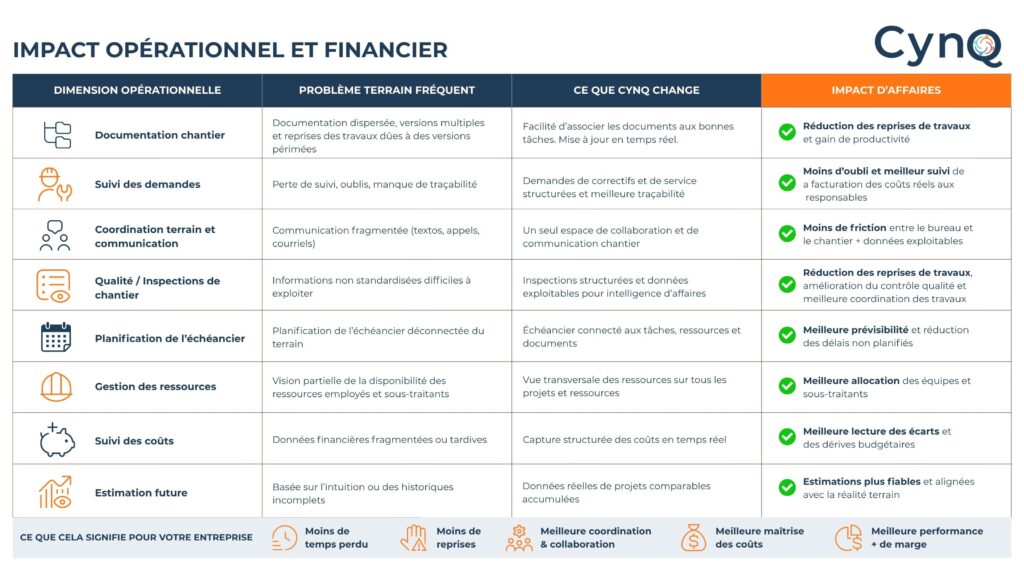
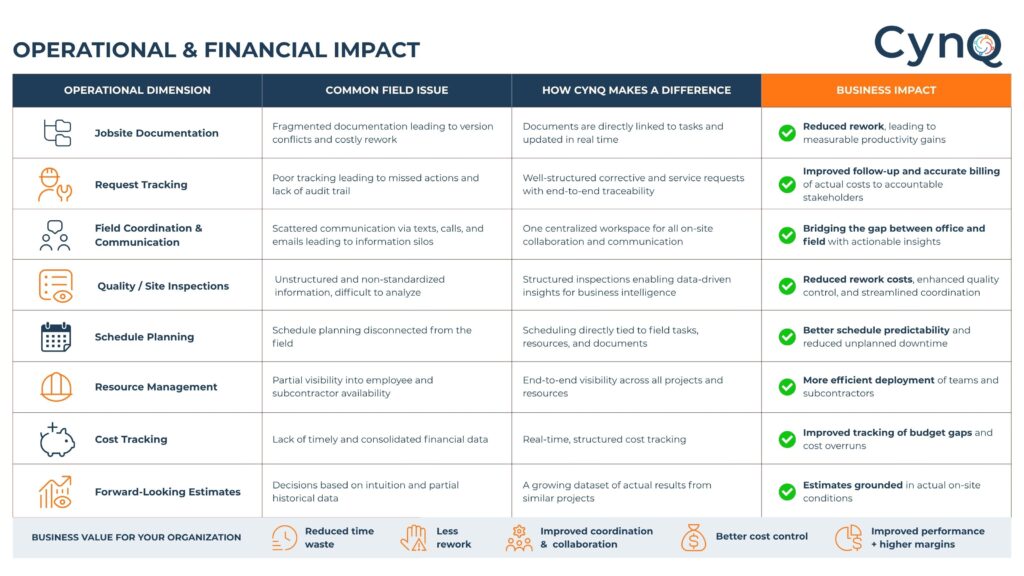
From centralizing documentation and organizing change requests to integrating inspections, timelines, and financial data—each step delivers immediate value without disrupting existing operations.
And that’s when the return on investment really starts to pay off.
It’s not just a matter of productivity or efficiency. It directly reduces the hidden losses that undermine project profitability:
- Time wasted searching for information
- Unnecessary rework
- Coordination issues between teams
- Decisions made without reliable field data
- Cost overruns that are difficult to predict
CynQ is specifically designed for entrepreneurs managing mid-sized residential and commercial projects—where margins are tight, operations are complex, and every inefficiency has a direct impact on profitability.
Ready to build differently? Contact us for a free 14-day trial or a personalized demo .